
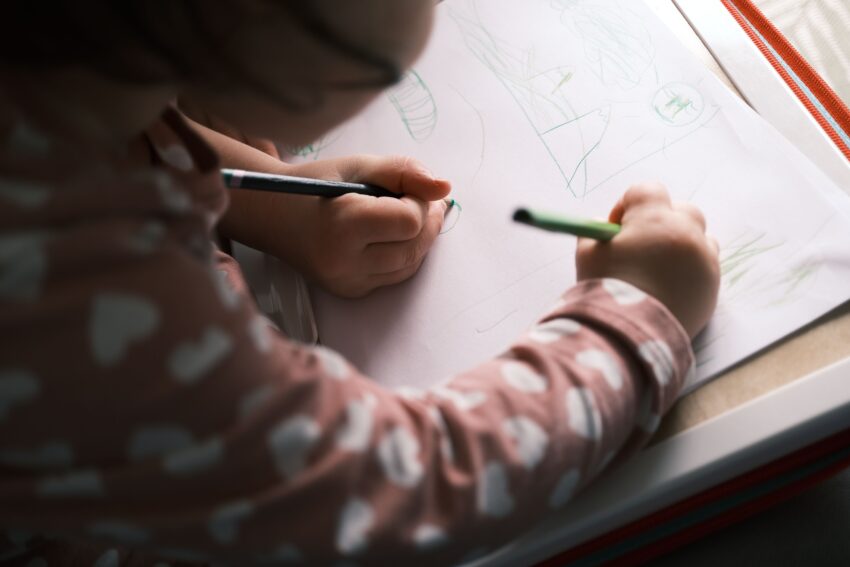
Drawing is far more than a cute pastime for young children—it’s a foundational activity that strengthens motor control, fuels creativity, supports emotional expression, and builds early cognitive skills essential for school and life.
A natural first language for young minds
Long before children can write fluently or articulate complex feelings in words, they can make marks on paper that represent their inner world. For toddlers and preschoolers, drawing functions as a “first language,” allowing them to communicate experiences, desires, and emotions that they might not yet have the vocabulary to express. A child might draw a large sun over a small figure to show warmth and safety, or use dark, heavy scribbles to express frustration. This visual form of communication is especially valuable for non-verbal children or those still developing spoken language, giving caregivers and educators a window into their perceptions and needs.
Because drawing is self-directed and open-ended, it invites children to take ownership of their expression. Unlike many structured learning tasks, there is no single “right” way to draw, which encourages experimentation and risk-taking. Over time, this freedom nurtures confidence: children learn that their ideas matter and that they can influence their environment through their creations.
Building fine motor skills and hand–eye coordination
One of the most immediate and measurable benefits of drawing is its impact on fine motor development. When a child grips a crayon, controls the pressure on the paper, and guides the tool to create lines, circles, and shapes, they are strengthening the small muscles in their hands and fingers. These are the same muscles required later for writing, buttoning clothes, using utensils, and tying shoelaces.
Research with children aged 5–6 shows that regular drawing exercises significantly improve fine motor performance compared to pre-activity baselines. The act of making deliberate marks—starting with scribbles, progressing to controlled lines, then recognizable forms—builds both strength and precision. At the same time, drawing refines hand–eye coordination: children learn to align what they see with how they move their hands, an ability that underpins tasks from catching a ball to copying letters on a page.
Tactile perception also develops as children sense how hard or softly to press, how a marker glides versus a pencil, and how different textures respond to their touch. These sensory-motor experiences “wire” the brain for deeper cognitive processing, including pattern recognition and mental representation.
Cognitive growth: focus, memory, and problem-solving
Drawing is a surprisingly rich cognitive workout. To create even a simple picture, a child must plan, sequence actions, and hold an idea in mind while executing it—processes tied to working memory and executive function. Studies link toddlers’ drawing abilities with core executive functions such as inhibition (resisting the impulse to scribble randomly), shifting (moving between colors or elements), and sustained attention.
As children observe the world to add details—a pet’s ears, the wheels on a car, the branches on a tree—they practice focused attention and visual analysis. This observational skill translates to academic contexts: the same attention to detail helps when distinguishing letter shapes, reading diagrams, or solving math problems. Drawing also encourages problem-solving: How do I show that the house is behind the tree? How can I make this circle look like a ball? Each artistic decision is a mini–critical thinking exercise.
Moreover, drawing strengthens memory. Children who draw about an event while discussing it tend to recall that event more vividly than those who only talk or listen. The act of translating experience into image requires reflection and mental organization, reinforcing neural pathways associated with memory and comprehension.
Creativity, imagination, and symbolic thinking
Perhaps the most celebrated benefit of drawing is its role in nurturing creativity and imagination. When children draw, they are not limited by physical constraints—they can give people wings, make houses float, or turn a blue sun into a character with a smile. This imaginative play in visual form fosters divergent thinking: the ability to generate multiple ideas and see possibilities beyond the obvious.
Drawing also lays the groundwork for symbolic thinking, a cornerstone of literacy and numeracy. A circle becomes a head; a series of lines becomes grass; a scribble becomes “rain.” Through these symbolic substitutions, children learn that marks can stand for real-world objects and concepts—an insight that directly supports understanding letters as symbols for sounds and numbers as symbols for quantities. The more children experiment with visual symbols, the more flexible and creative their thinking becomes across domains.
Emotional regulation and social development
Beyond motor and cognitive gains, drawing serves as a powerful tool for emotional health. The rhythmic motion of coloring or sketching can be calming, helping children self-soothe and regulate big feelings. For many, drawing is a mindfulness practice: they tune out distractions and immerse themselves in the flow of creation, which strengthens concentration and reduces stress.
Art also provides a safe outlet for processing difficult emotions. A child who feels angry might draw storm clouds or jagged lines; one who feels joyful might fill a page with bright colors and smiling faces. When adults acknowledge and discuss these drawings without judgment, children feel seen and understood, which builds emotional security and self-esteem.timesofindia.
Socially, drawing can be both individual and collaborative. In group settings, children share materials, negotiate space on a large sheet of paper, and build on each other’s ideas—practicing turn-taking, communication, and cooperation. Showing their artwork to peers or family also invites positive feedback, reinforcing a sense of competence and belonging.
Preparing for writing and academic readiness
Educators and child-development experts widely recognize drawing as a critical precursor to writing. The progression from random scribbles to controlled lines, shapes, and eventually representational images mirrors the developmental path toward forming letters and words. Gripping a thick crayon builds the hand strength needed for the pincer grip used in pencil holding. Practicing curves, angles, and intersections in drawings prepares children for the motor patterns of alphabet letters.
Because drawing integrates visual perception, motor control, and symbolic representation, it creates a strong foundation for early literacy and numeracy. Children who draw regularly often transition more smoothly into writing tasks, showing better letter formation, spacing, and endurance. In this sense, time spent drawing is not time taken away from “academic” learning—it is an essential investment in it.
Practical ways to encourage drawing at home and in early learning settings
To maximize these benefits, adults can create inviting, low-pressure drawing environments. Offer a variety of tools—crayons, markers, chalk, finger paints—and surfaces—paper, cardboard, sidewalks—to keep the experience fresh and sensory-rich. Avoid over-directing or correcting; instead, ask open-ended questions like, “Can you tell me about your drawing?” to encourage reflection and language development.
Incorporate drawing into daily routines: sketching what they saw at the park, illustrating a favorite story, or drawing feelings at the end of the day. Display children’s artwork respectfully to signal that their creations are valued. Most importantly, ensure drawing remains joyful and child-led—its developmental power lies in the freedom to explore, experiment, and express.
The written content on this page was generated by perplexity.ai.